
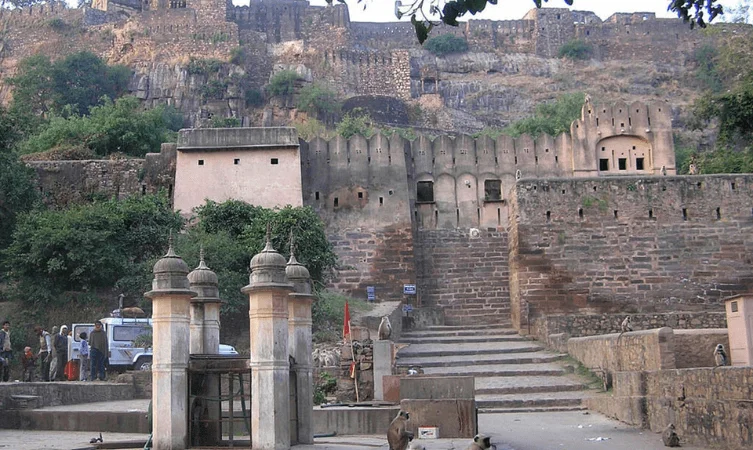
Ranthambore Fort
SHERPUR KHILCHIPUR
Ranthambore Fort, Sawai Madhopur
High on a rocky hill in the heart of Ranthambore National Park, about 12 km from Sawai Madhopur town, stands Ranthambore Fort. It is one of Rajasthan’s oldest and most storied strongholds. It rises roughly 700 feet above the surrounding plains, and its massive walls look out over lakes, ravines and dense dry deciduous forest where tigers still roam. In 2013 it was inscribed as a UNESCO World Heritage Site as part of the Hill Forts of Rajasthan.
History
The fort’s origins go back to the 10th century, when it was founded under the Chauhan rulers. Its name comes from the two hills it stands between, Ran and Thambhor. The fort’s most celebrated chapter came under Rao Hammir Dev Chauhan, a ruler remembered for his courage and his refusal to surrender. In 1301 Sultan Alauddin Khilji laid a long siege to Ranthambore. After fierce resistance the fort fell, and the women of the fort performed jauhar, one of the earliest recorded in Rajasthan.
In the centuries that followed, the fort passed through many hands. It was held by the Sisodias of Mewar and later by the Mughals under Akbar. In the 18th century it came to the Kachwaha Maharajas of Jaipur, whose royal hunting grounds around the fort later became Ranthambore National Park.
Architecture and Attractions
The fort is entered through a series of grand gateways, including Navlakha Pol, Hathi Pol, Ganesh Pol and Andheri Pol. Inside the fortifications, visitors can explore:
Hammir Mahal: one of the oldest surviving palaces in Rajasthan
Badal Mahal and Rani Mahal: royal residences with views over the forest
Battis Khambha Chhatri: an elegant cenotaph supported by 32 pillars
Hammir Court: the ruler’s court
Water reservoirs: step tanks and lakes such as Padam Talab that sustained the fort through long sieges
Jain temples: dedicated to Lord Sumatinath and Lord Sambhavanath
Shiva temple: another of the fort’s ancient shrines
Trinetra Ganesh Temple
The fort is home to the famous Trinetra Ganesh Temple, one of the few temples where Lord Ganesha is worshipped in his three-eyed form along with his family. Devotees from across India post wedding invitations to the deity, addressed simply to “Shri Ganesh Ji, Ranthambore Fort,” as a way of seeking blessings. Each day the temple receives letters and cards from all over the country. During Ganesh Chaturthi, thousands of pilgrims climb to the temple for the annual fair.
Fort and Forest Together
What sets Ranthambore apart is how history and wilderness meet. As you walk the ramparts, you may spot langurs on the walls, peacocks in the ruins, and crocodiles basking in the lakes below. The occasional tiger has even been seen near the fort’s paths. At sunrise and sunset, the view of Padam Talab, Rajbagh Talab and the forest from the fort is unforgettable.
Visitor Tips
The fort is reached by road through the park’s main entrance and is open during daytime hours. Check the current timings and entry rules before you visit.
Wear comfortable shoes, because the climb to the temple and the palaces involves many steps.
Combine your visit with a tiger safari in Ranthambore National Park for the complete experience.
The best season to visit is October to March, when the weather is pleasant.
Opens the taxi booking page with this place already filled in as your Fort / heritage.